"What did you learn today?"
"Nothing."
Every parent of an 11 to 13 year old has had this conversation, usually in the car, usually more than once a week. It's not that they learned nothing. It's that the question is almost impossible to answer at 3:30 pm, and by Grade 6 most kids have figured out that "nothing" ends the conversation fastest.
Here's why it happens, what to ask instead, and how to find out what's going on without turning pickup into a cross-examination.
Why "nothing" is the honest answer (sort of)
The question is too big. A school day is six hours of math, reading, gym, recess, a group project and a fire drill. Asking a kid to summarize it is like asking you to summarize your whole workday in one sentence the second you walk in the door.
They're tired. Tweens spend the day managing friendships, following instructions and sitting still. The ride home is the first moment they can switch off.
Middle schoolers want more privacy. Around Grade 6, kids naturally start keeping more of their world to themselves. That's a normal part of growing up, not a sign something is wrong.
Sometimes they don't know. In Grades 7 and 8, a lot of learning is building on earlier topics. A kid working on integers may not think of it as "learning something new," because it feels like more of the same math.
Questions that actually get answers
Swap the big question for small, specific ones. These work better with Grade 6 to 8 kids:
- "What was the hardest thing you did today?"
- "What are you doing in math right now?"
- "Did anything happen in class that made you laugh?"
- "Who did you sit with at lunch?"
- "If you could skip one class tomorrow, which one?"
- "What's something your teacher said that you thought was wrong?"
- "Is there a test or project coming up?"
Two tips that help more than the questions themselves:
Pick your moment. Many kids open up later: at dinner, during a drive to practice, or right before bed. If pickup always gets "nothing," stop asking at pickup.
Share first. Tell them something about your day, including something that went badly. It makes the conversation feel like an exchange, not a check-in.
Signs it might be more than "nothing"
Most of the time, "nothing" is just "nothing." But keep an eye out for:
- A subject they used to talk about and now avoid completely
- "I don't get it" turning into "I hate math"
- Grades or teacher comments dropping in one subject
- Taking much longer than usual on schoolwork, or saying there's none for weeks at a time
- A drop in the "independent work" or "self-regulation" learning skills on the report card
Any of these is a reason to email the teacher. Ask what topic the class is on and whether they've noticed anything.
The better answer: see it, don't ask for it
The most reliable way to know what your child is learning is to see their work. That's hard in middle school, when most of it stays at school or happens on a school laptop.
That's the problem Homebell was built for.
- Set it up in about five minutes. Choose the grade, your school board and the subjects. No names needed.
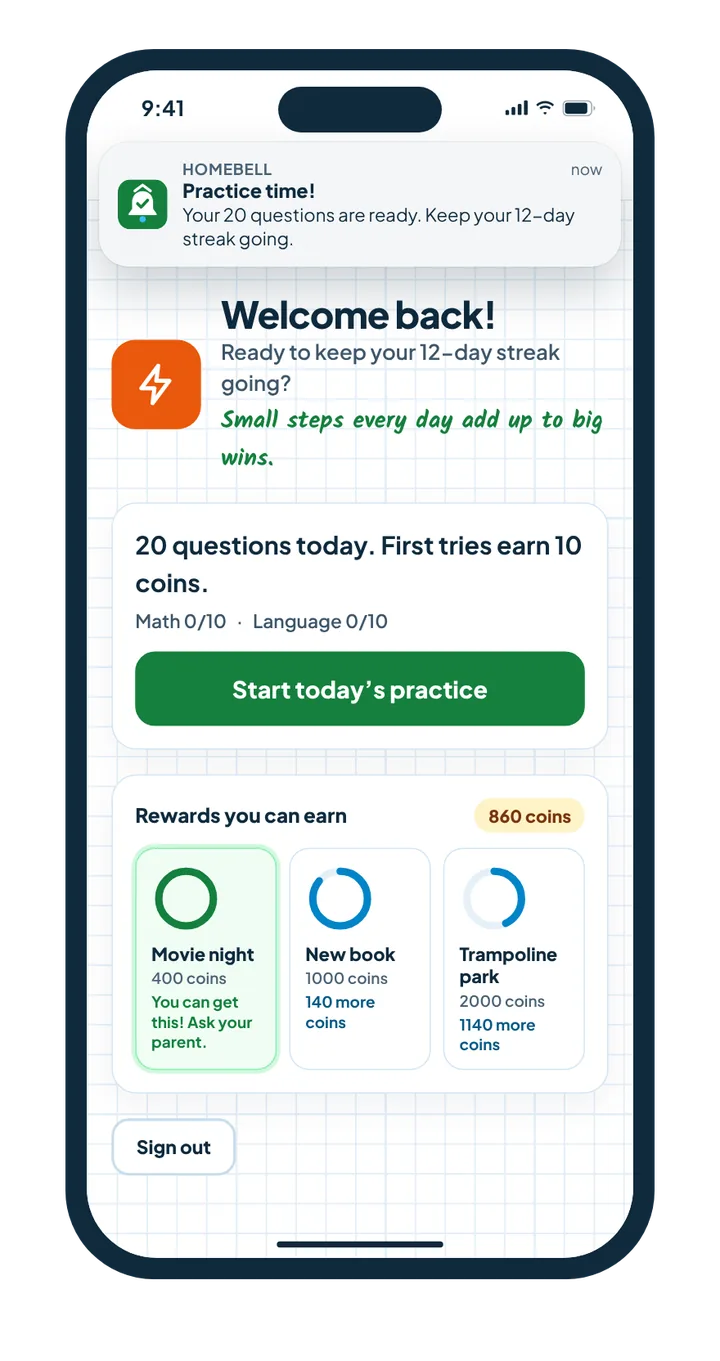
- Practice shows up at the time you pick, say 4:00 pm or after dinner, only on school days. It skips PA days and holidays on your board's calendar automatically.
- Questions follow the order topics are usually taught in Ontario for that grade. If the class is ahead or behind, tell Homebell what they're on and practice follows.
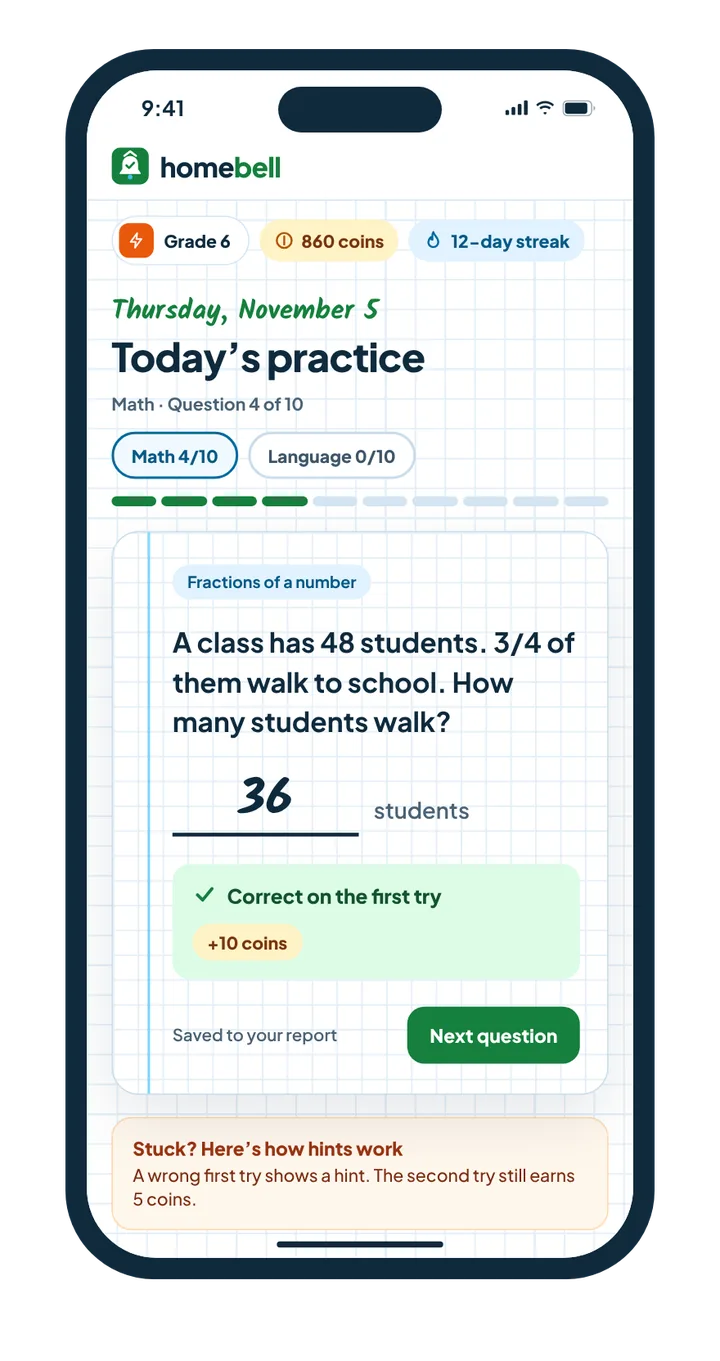
- Answers are checked on the spot. A hint after a wrong answer, then another try, then a short explanation.
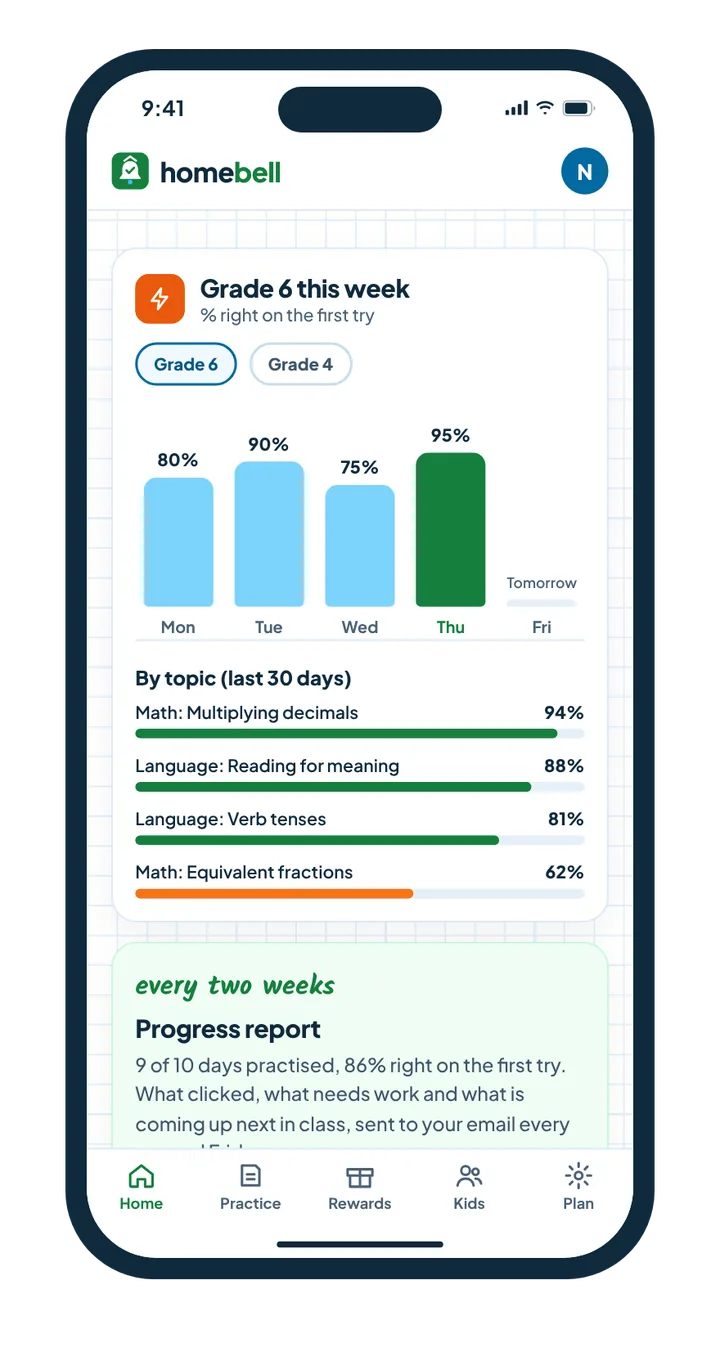
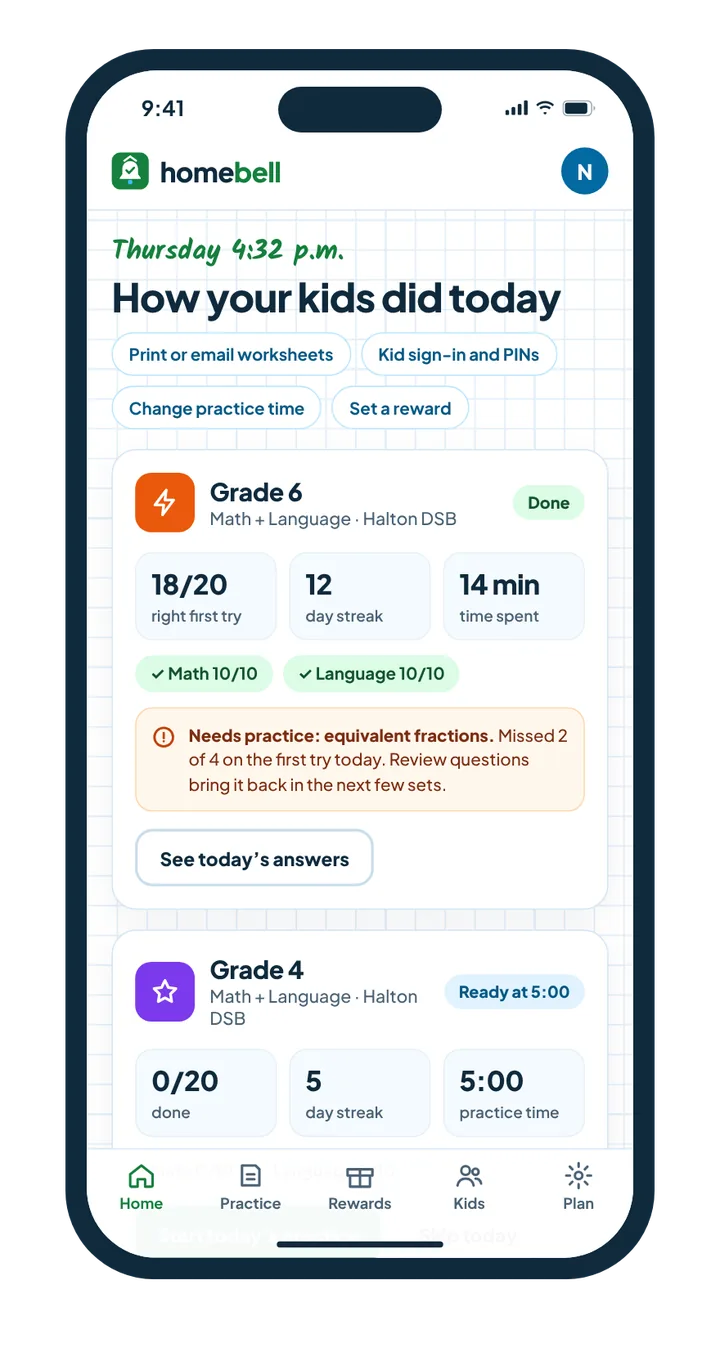
- You see the results. Which topics they're getting right on the first try, and which ones need more work.
So instead of "What did you learn today?" you can ask, "I saw you got all the integer questions right. Is that what you're doing in math?" That's a conversation a 12 year old will actually have.
Try it free for 7 daysNo card needed for the trial.
Quick answers
Is it normal for a Grade 7 student to say nothing about school?
Yes. Wanting more privacy is a normal part of being 11 to 13. It's worth paying attention only when it comes with other changes, like falling marks or avoiding a subject.
How do I know what topic my child is on in math?
Ask the teacher, check the class page or newsletter if there is one, or use practice that follows the usual order of the Ontario curriculum for their grade.