The fall progress report lands sometime between late October and late November, and for a lot of parents it raises more questions than it answers. There's no mark on it. There are phrases like "progressing well" and a row of letters next to words like "self-regulation." Then in February a real report card arrives, and in Grades 7 and 8 it suddenly has percentages.
Here's what each part means, and what you can do with it.
Ontario gives three reports a year
Every elementary student in Grades 1 to 8 gets three formal reports:
| Report | When it comes home | What it shows |
|---|---|---|
| Fall progress report | Between October 20 and November 20 | No marks. Progress is described as "very well," "well," or "with difficulty" |
| First provincial report card | Between January 20 and February 20 | Marks for each subject, plus learning skills and teacher comments |
| Second provincial report card | End of June | Marks for the second half of the year |
Your board sets the exact dates inside those windows.
The fall report is the one parents tend to skim. It shouldn't be. It's the earliest written signal of the year, and "with difficulty" in October gives you three months to help before anything is graded.
Letter grades in Grade 6, percentages in Grades 7 and 8
On the provincial report card, Grades 1 to 6 get letter grades and Grades 7 and 8 get percentage marks. That switch catches families off guard. A Grade 6 student who was a steady "B" can come home in Grade 7 with a 71%, and it feels like a drop even when nothing has changed.
Both are built on the same four achievement levels:
| Level | What it means | Grade 6 letter | Grade 7 and 8 percentage |
|---|---|---|---|
| Level 4 | Achievement surpasses the provincial standard | A range | 80 to 100% |
| Level 3 | Achievement meets the provincial standard | B range | 70 to 79% |
| Level 2 | Approaches the standard | C range | 60 to 69% |
| Level 1 | Much below the standard | D range | 50 to 59% |
Level 3 is the target. It means your child has met the grade's expectations. It is not "average" in the sense of "just okay." A B or a 75% in Grade 7 means they're where the curriculum expects them to be.
What deserves a closer look is a slide from Level 3 toward Level 2 in one subject, especially math. Math is where gaps stack: a shaky handle on fractions in Grade 6 shows up as trouble with ratios and percents in Grade 7, then with algebra in Grade 8.
The learning skills section
Below the marks, every report card rates six learning skills and work habits:
- Responsibility
- Organization
- Independent work
- Collaboration
- Initiative
- Self-regulation
Each gets a letter: E (excellent), G (good), S (satisfactory) or N (needs improvement).
These are worth more attention than they usually get. Teachers often see a dip in "independent work" or "self-regulation" before the marks move. If your child has an S or N in independent work, it usually means they need help getting started on tasks or staying with them without someone nearby.
The comments are where the real information is
The teacher comments are short, but they're written for you. Look for three things:
- Named topics. "Is developing an understanding of integers" tells you exactly what to practise.
- Next steps. Most comments end with one. That's the teacher telling you what would help most at home.
- Words like "with support" or "with prompting." These mean your child can do it, but not on their own yet.
What to do after the report card comes home
Write down the topics. Pull every named topic out of the comments into one list.
Ask the teacher one specific question. "What's one thing we could practise at home for 10 minutes a day?" gets a better answer than "How is she doing?"
Don't wait for the next report card to check again. The next one is three or four months away. A short check every couple of weeks tells you whether the extra practice is working while there's still time to change course.
How Homebell fills the gap between report cards
Report cards come three times a year. Homebell gives you a progress report every two weeks.
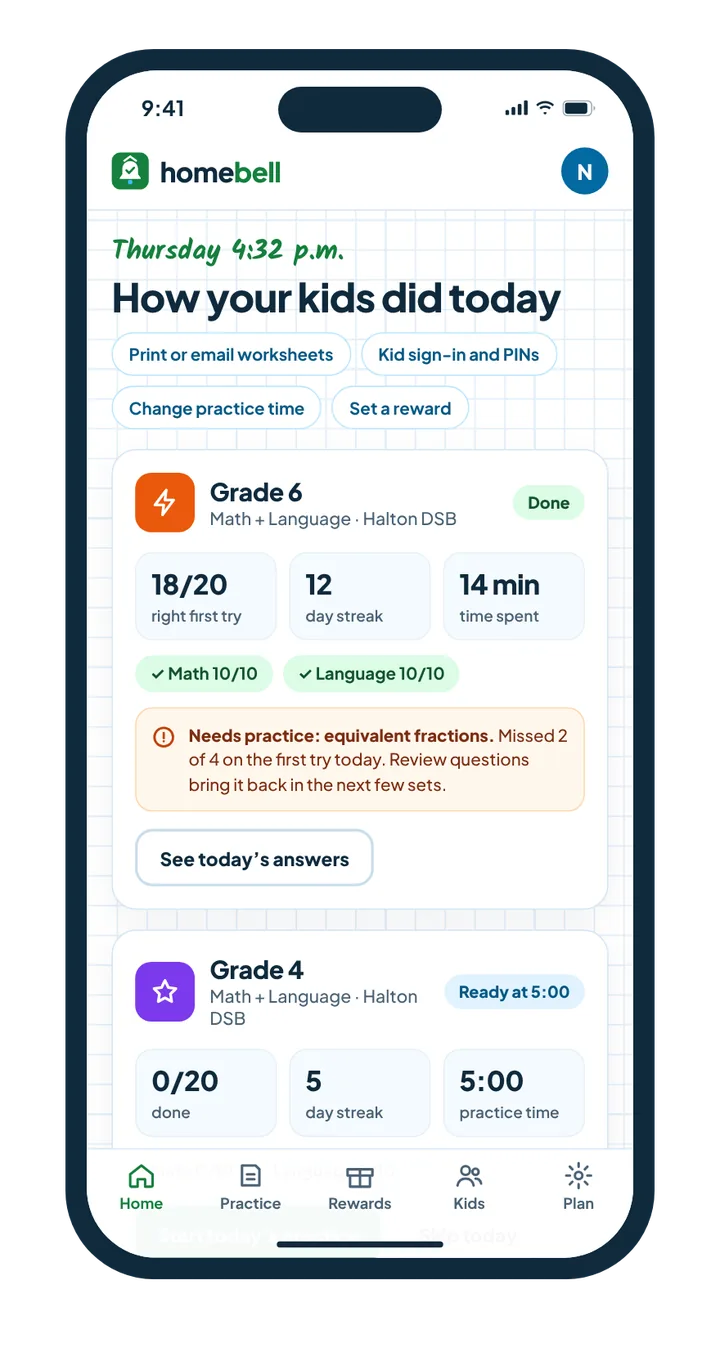
Here's how it works for a Grade 6, 7 or 8 student:
- You set it up once. Pick the grade, your school board and the subjects. No names or photos needed, just an avatar so you can tell siblings apart.
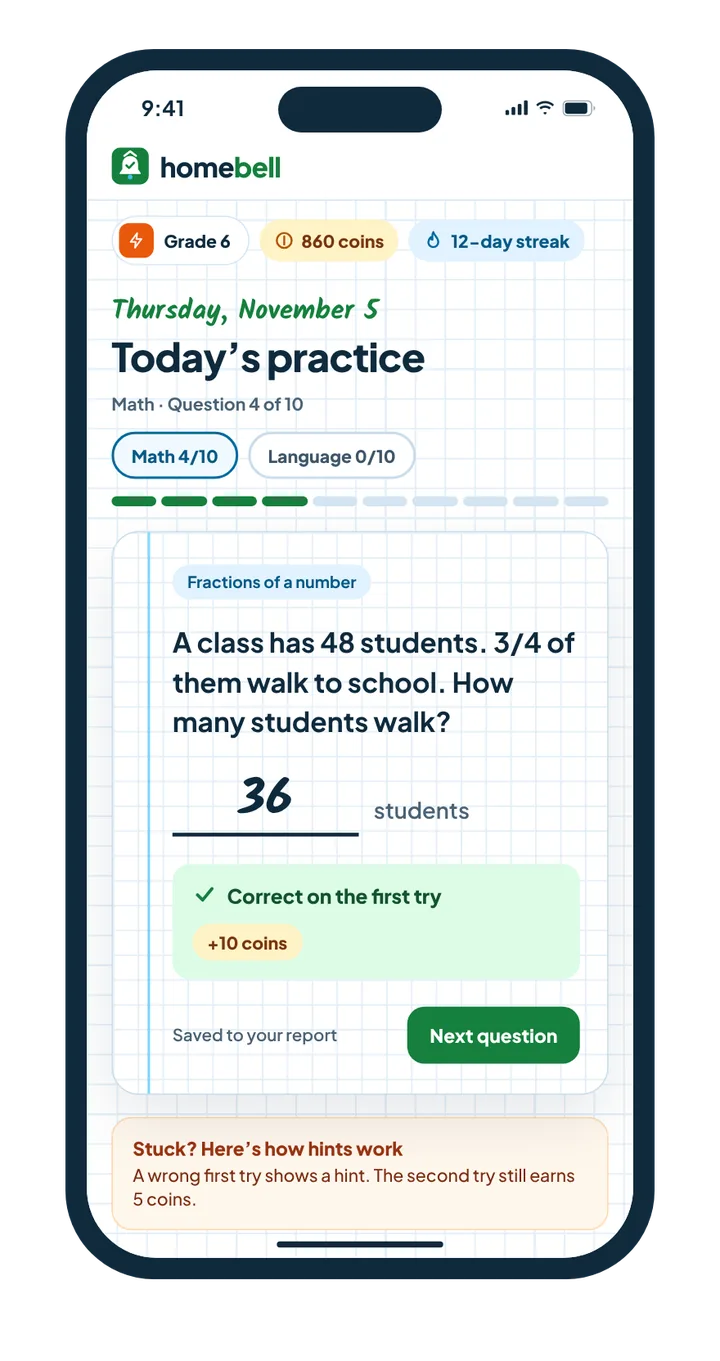
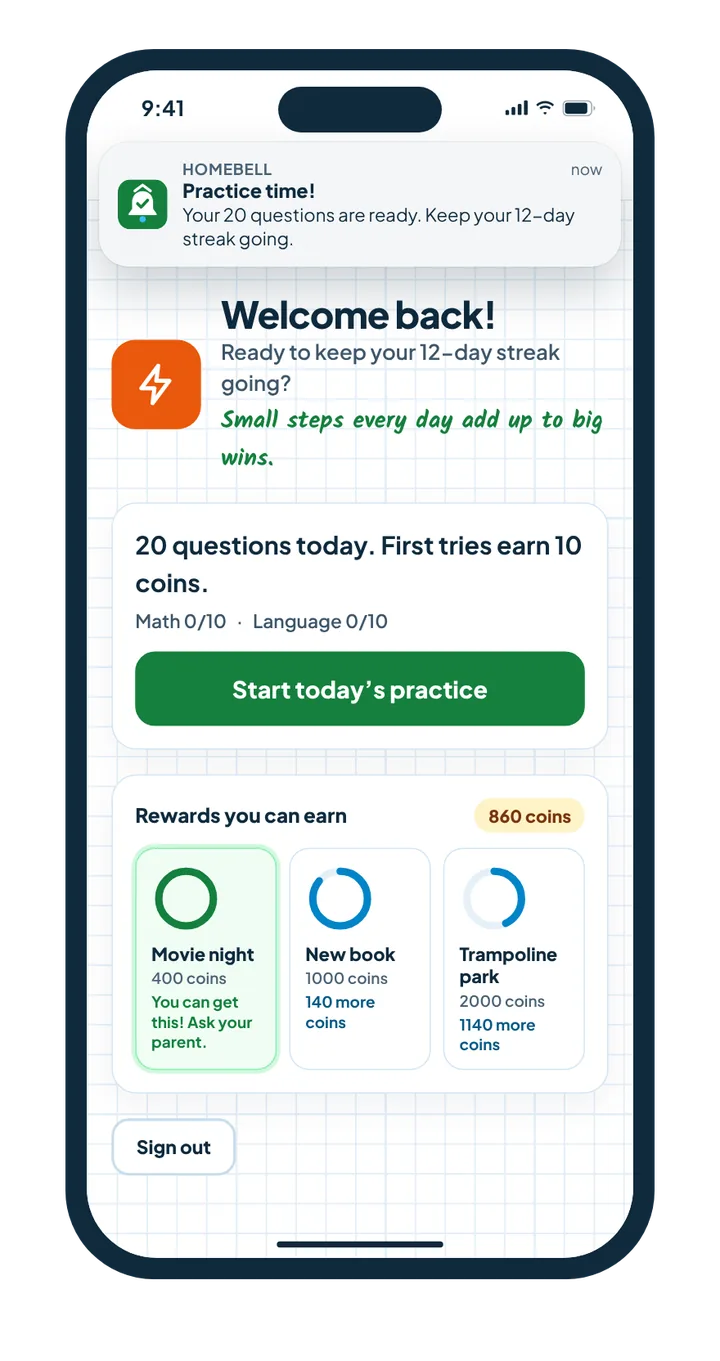
- Practice arrives at a time you choose, only on school days. Your child gets about 10 questions per subject, in the order topics are usually taught for that grade. If the report card named a topic, you can point practice straight at it.
- Every answer is checked on the spot. A wrong answer gets a hint, then a second try, then a short explanation. You don't mark anything.
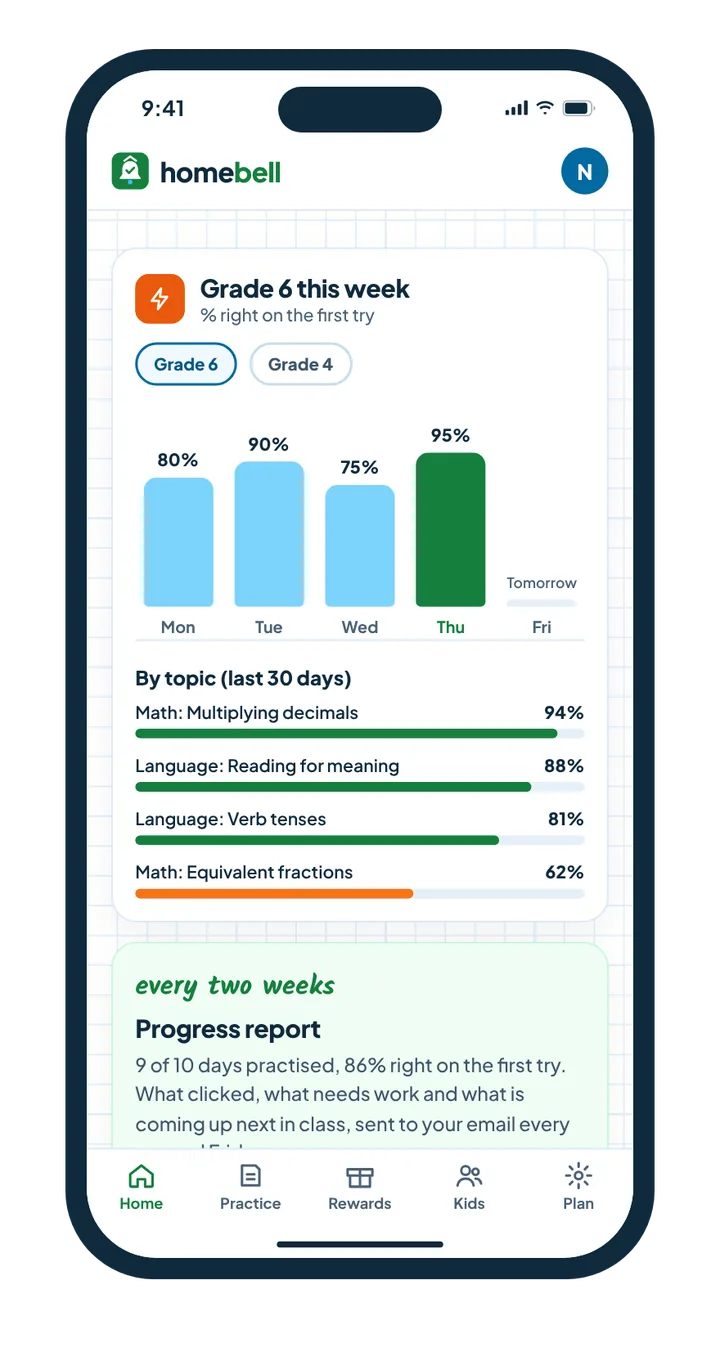
- You see what's working. The parent dashboard shows first-try accuracy and which topics need more practice, so by February you already know what the report card is going to say.
Homebell follows the Ontario curriculum for Math, Language, French, Science and Social Studies, and skips PA days and holidays on your board's calendar.
Try it free for 7 daysNo card needed for the trial.
Quick answers
Does the fall progress report count toward the final mark?
No. It has no marks. It's an early check-in on how your child is progressing.
Is a Level 3 or a B good?
Yes. Level 3 means your child is meeting the provincial standard for their grade.
Why did my child's mark seem to drop in Grade 7?
Often it didn't. Grade 7 switches from letter grades to percentages, and a percentage in the 70s is the same Level 3 as a B.