Grade 7 is when math changes. It's the first year with percentage marks on the report card, the first year with negative numbers everywhere, and the year algebra starts to feel like real algebra. Plenty of kids who coasted through Grade 6 hit a wall somewhere in the first term.
Here's what's in the Grade 7 curriculum, the topics that trip students up most, and how to catch a gap early.
What's in Grade 7 math
The Ontario math curriculum for Grade 7 has these strands:
- Number: integers, fractions, decimals, rational numbers, perfect squares and square roots, factors and multiples
- Algebra: patterns, solving equations, mathematical modelling, and coding
- Data: graphs including circle graphs, data analysis, and probability with independent and dependent events
- Spatial sense: circles (radius, diameter, circumference), area, surface area and volume of cylinders, and dilations
- Financial literacy: saving, borrowing, interest, fees, investments and exchange rates
- Social-emotional learning skills: building confidence and coping when math gets hard
The four topics kids struggle with most
1. Integers
Negative numbers are new territory. Most students can add 5 + (-3) once they see it, but mixing all four operations with negatives, like -4 × (-6) or -12 ÷ 3, takes practice. The rules have to become automatic, because every algebra unit after this uses them.
Sign of a gap: your child gets the number right but the sign wrong.
2. Fractions and rational numbers
Grade 7 expects students to add, subtract, multiply and divide fractions, including mixed numbers. Fractions are the most common hidden gap in middle school math. A student who still struggles to find a common denominator will find ratios, percents and equations much harder.
Sign of a gap: converting everything to decimals to avoid fractions, or guessing at common denominators.
3. Solving equations
Grade 7 students solve equations like 4x - 7 = 21. The idea of "doing the same thing to both sides" is simple, but the steps need to be done in order and written out clearly.
Sign of a gap: getting the right answer by guess-and-check but not being able to show the steps.
4. Circles and measurement
Circumference, area and volume of cylinders bring in π and a set of formulas to remember. Students often mix up radius and diameter, or area and circumference.
Sign of a gap: using the right formula with the wrong measurement.
How to spot a gap early
Most parents find out about a math gap from the report card. By then, the class has moved on. Catch it sooner by:
- Asking what unit they're on, then asking them to show you one question from it
- Watching for "I hate math," which is often "I don't get this one thing" in disguise
- Reading the fall progress report closely. "With difficulty" next to math in November is your early warning
- Checking how long math takes. A big jump in time spent usually means confusion, not effort
What helps
Short and often beats long and rare. Ten minutes of math most days builds fluency. A two-hour session the night before a test mostly builds stress.
Practise the topic the class is on now, plus a quick review of earlier ones. Math in Grade 7 builds on itself, so old gaps resurface.
Let mistakes happen. Getting a question wrong, seeing why, and trying again is how math sticks.
How Homebell catches gaps before the report card does
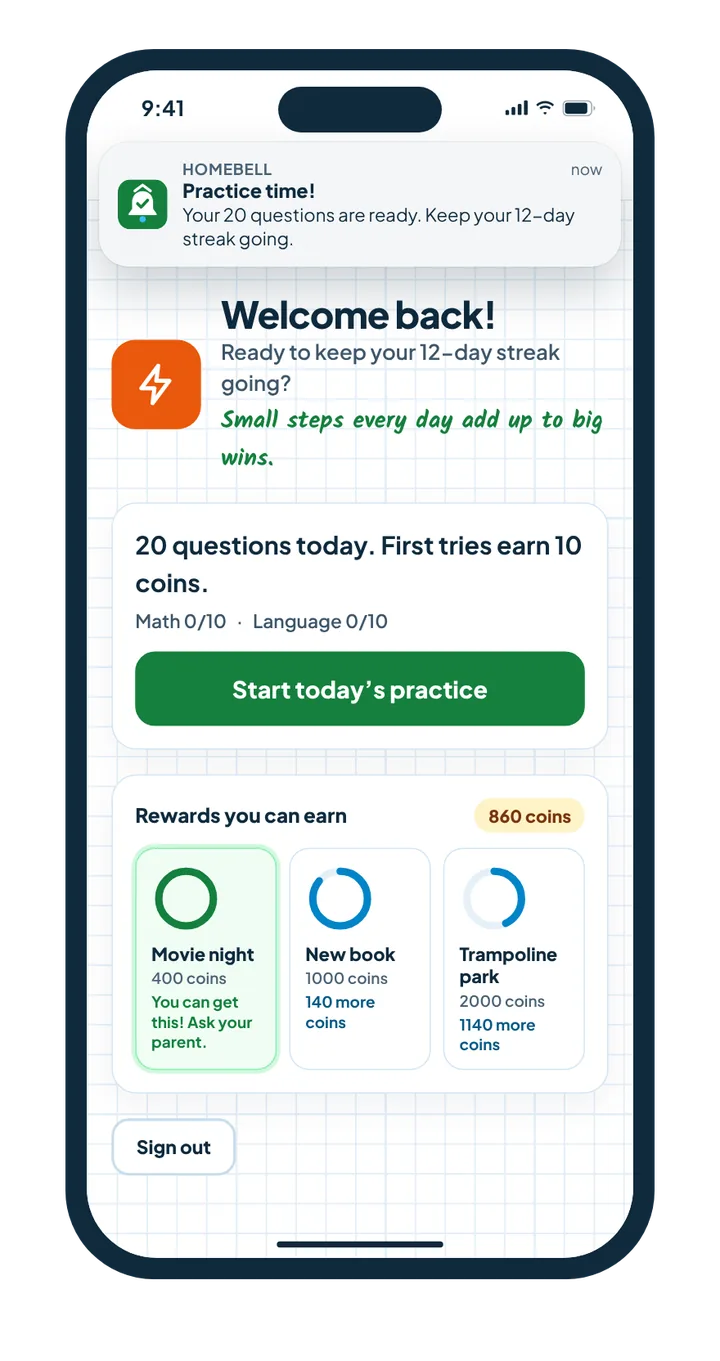
Homebell gives Grade 7 students short daily practice that follows the order Ontario classes usually teach these topics.
- Set up Grade 7 with your school board. Pick Math, and add Language, French, Science or Social Studies if you want.
- About 10 questions a day arrive at the time you choose, on school days only. If the class is ahead or behind, tell Homebell which topic they're on.
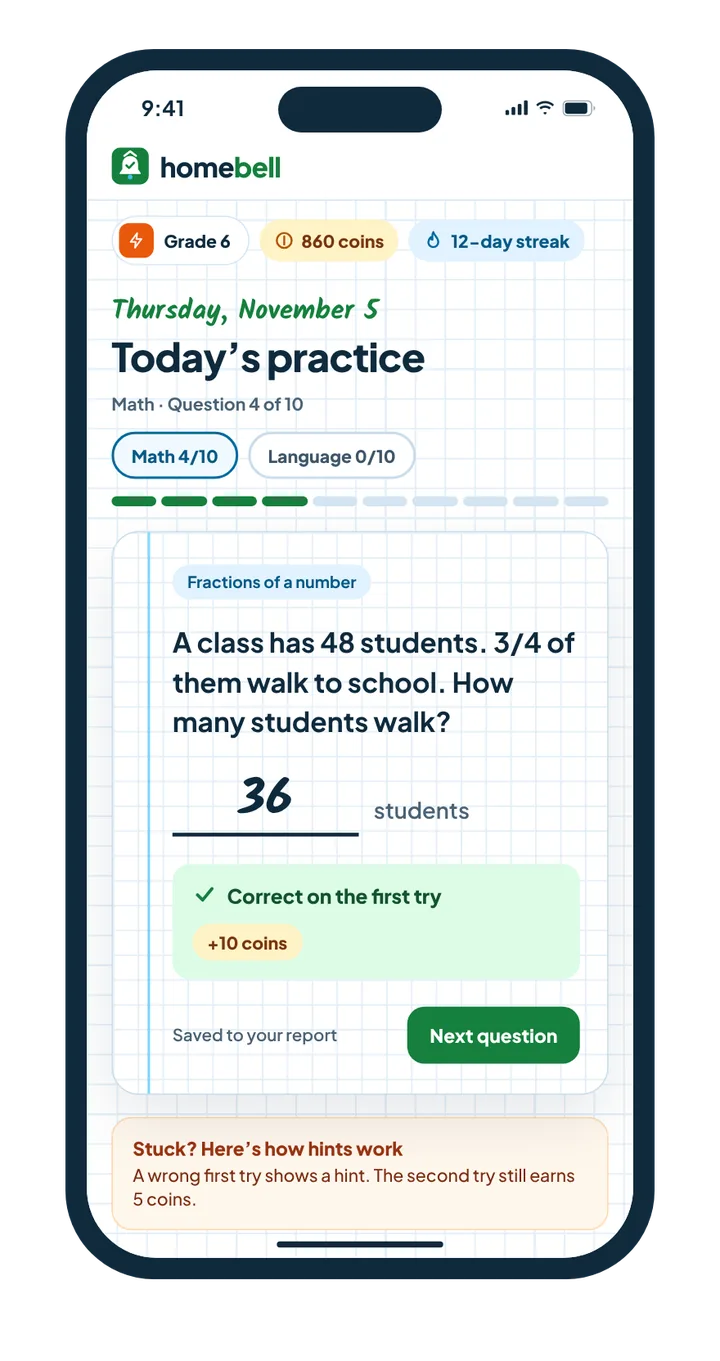
- Answers are checked instantly. A wrong answer gets a hint and a second try, then a short explanation. Students earn coins for first-try answers.
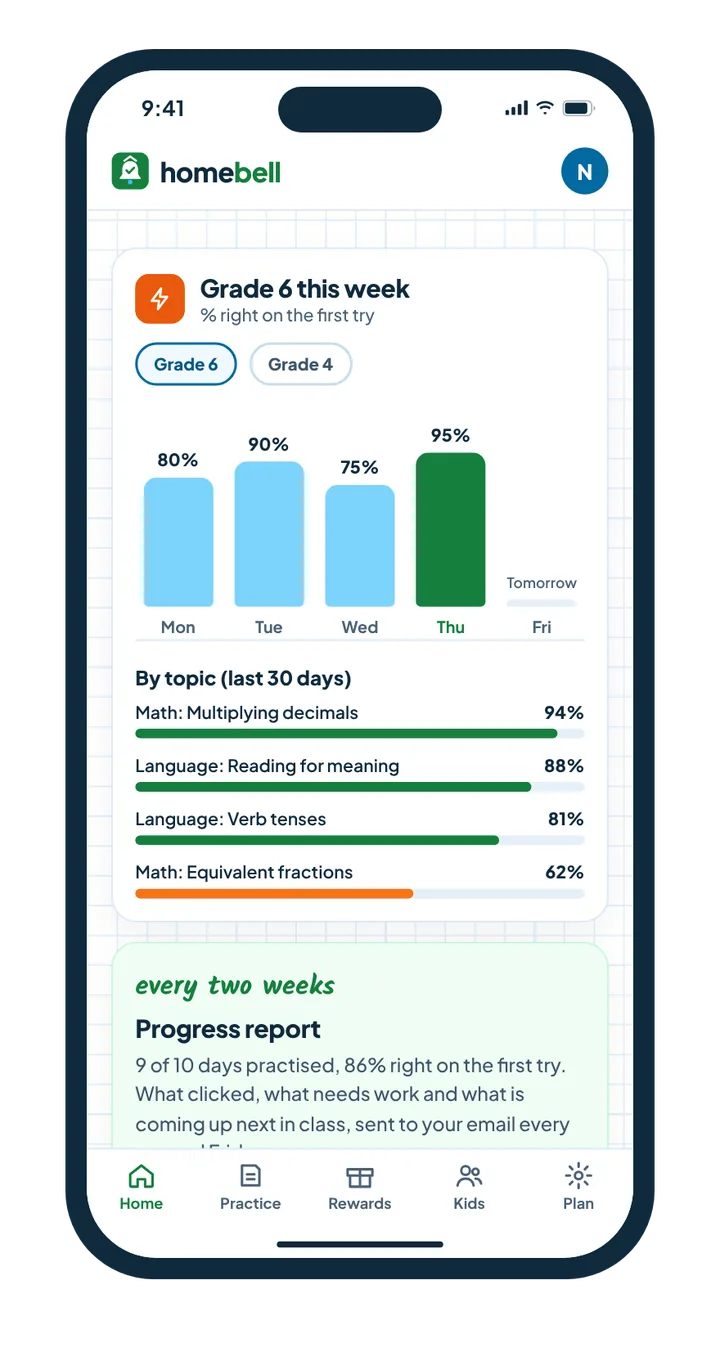
- You see which topics need work. The parent dashboard tracks first-try accuracy by topic, so a gap in integers or fractions shows up within days, not months.
Try it free for 7 daysNo card needed for the trial.
Quick answers
Why is Grade 7 math so much harder than Grade 6?
Negative numbers, operations with fractions and more formal algebra all arrive at once, and Grade 7 is the first year marks appear as percentages.
Is coding part of Grade 7 math in Ontario?
Yes. Coding is part of the algebra strand in the Ontario math curriculum for every grade from 1 to 9.
My child gets 70% in math. Is that okay?
A mark in the 70s is Level 3, which means meeting the provincial standard. It's worth looking at the comments to see which topics are holding them back from Level 4.