At some point in Grade 6, the letter about EQAO comes home. For many kids it's the first province-wide test they'll write, and for parents it raises the same questions: what is it, does it count, and should we be doing something about it?
Here's a calm, practical guide.
What EQAO is
EQAO (the Education Quality and Accountability Office) runs province-wide assessments in Ontario in Grades 3, 6, 9 and 10. The Grade 6 assessment checks reading, writing and math against the Ontario curriculum.
The results are mainly used to show how students, schools and boards are doing compared with the provincial standard. Each family also receives an individual student report.
When it happens
The Grade 6 assessment is written in the spring. Boards are listing a provincial window of May 26 to June 4, 2027. Each school picks its own dates inside the window and sends a letter home beforehand.
How it works
- Two parts: language (reading and writing) and mathematics.
- Short sessions: the language part is split into sessions and the math part into stages. Each takes roughly 30 minutes and is written in one sitting.
- Written online, on a school computer or device.
- Spread over several days, so no single day is long.
How Grade 6 students are doing
In the 2025 to 2026 school year, in English-language schools:
| Grade 6 | Students meeting the provincial standard |
|---|---|
| Reading | 86% |
| Writing | 85% |
| Mathematics | 52% |
Reading and writing are strong. Math is the gap: about half of Grade 6 students met the standard. If your child finds math harder than language, they're in good company, and math is where steady practice makes the biggest difference.
What's in the Grade 6 math
The math questions follow the Ontario curriculum strands for Grade 6:
- Number: fractions, decimals, percents, ratios, whole numbers up to one million, and operations with them
- Algebra: patterns, equations and simple coding
- Data: graphs, reading data, and probability
- Spatial sense: geometry, area, angles and measurement
- Financial literacy: budgets and money decisions
Word problems are common. Many students lose marks not because they can't do the math, but because they misread what the question is asking.
A calm preparation plan
You don't need workbooks or weekend cram sessions. What helps most is regular, short practice through the year.
From now until March: build the basics. A few minutes of math most days keeps skills fresh. Focus on fractions, decimals and multiplication facts, because so many other topics depend on them.
March and April: look for gaps. Use the February report card and the teacher's comments to find the topics that need work, and practise those.
May: practise the format. EQAO has free sample questions on its website, and our free Grade 6 EQAO practice test has 12 more. Doing a few together shows your child what the questions look like on screen.
The week of the assessment: keep it normal. Sleep, breakfast, and a calm morning matter more than last-minute review. Remind your child it's one snapshot, not a final verdict.
How Homebell helps with steady practice
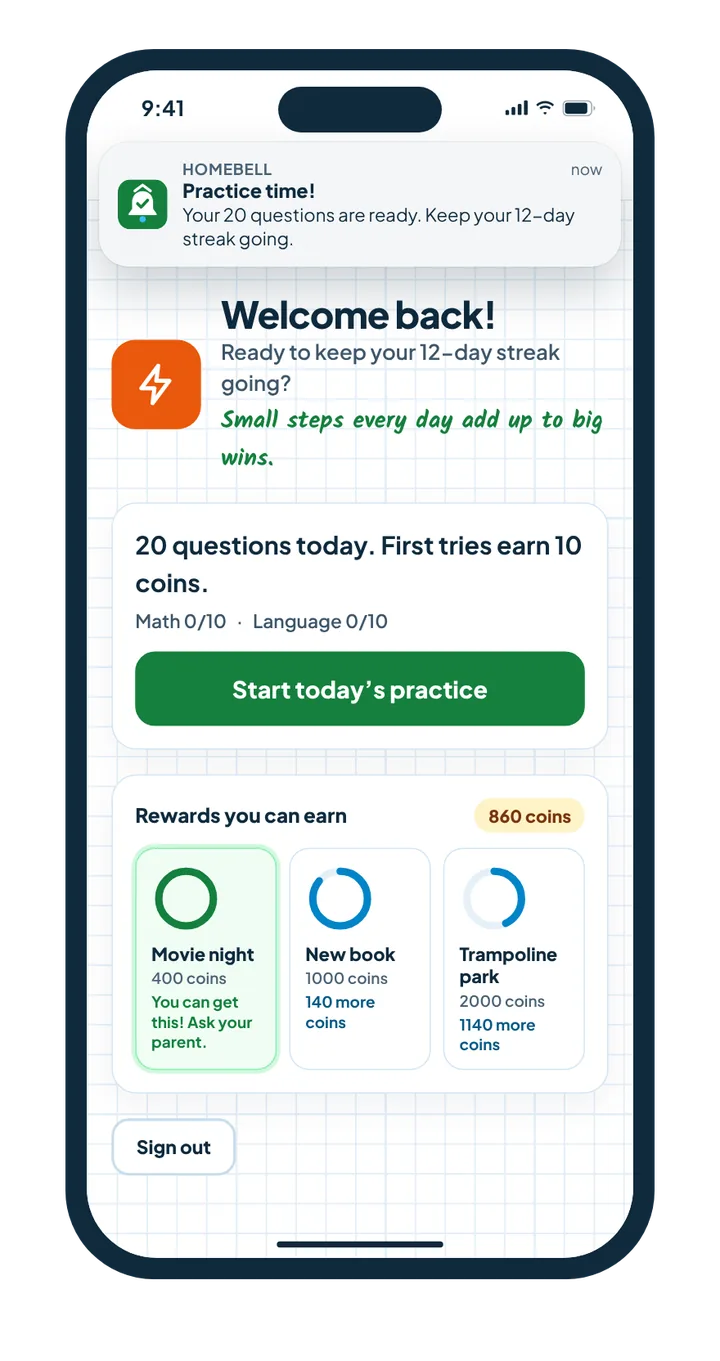
Homebell is built for exactly the kind of practice that helps before EQAO: short, daily, and matched to the Grade 6 curriculum.
- Set up Grade 6 with your school board and subjects. Math and Language are the two EQAO areas.
- About 10 questions a day per subject arrive at the time you choose, on school days only.
- Questions follow the order topics are usually taught in Grade 6, so practice lines up with class.
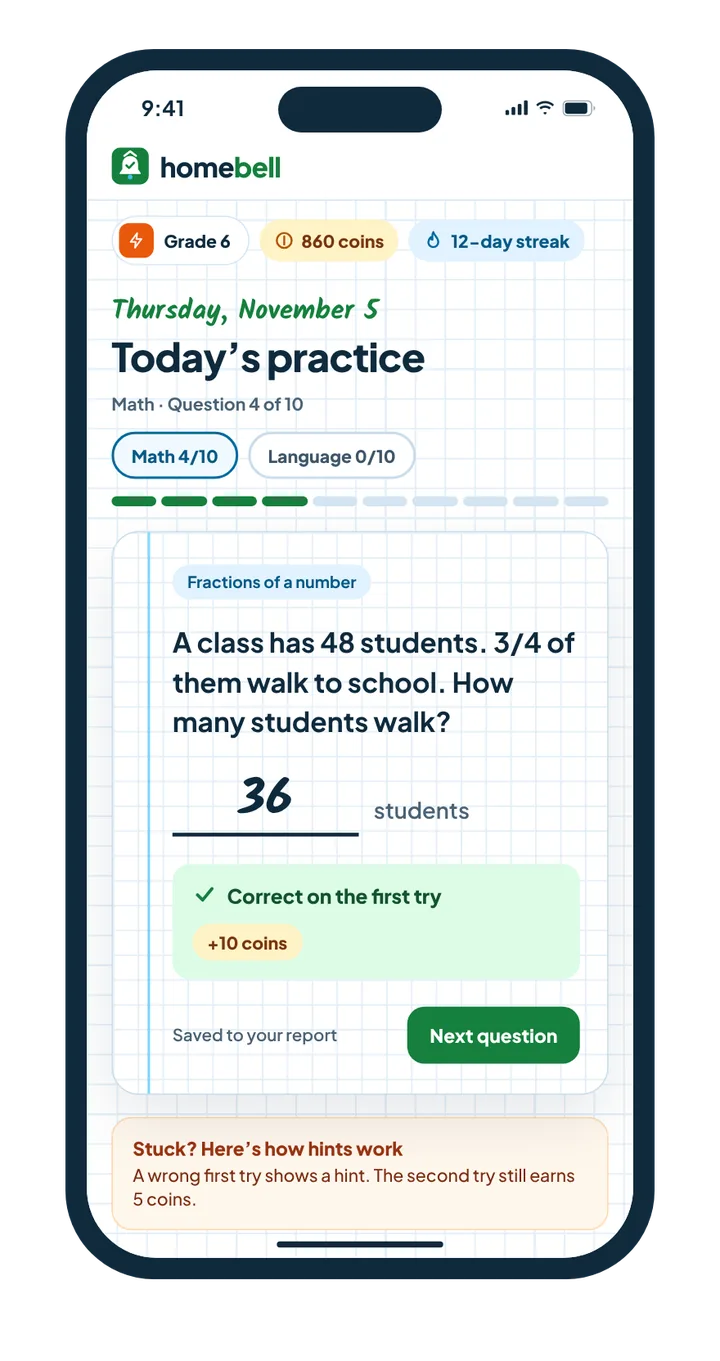
- Every answer is checked instantly, with a hint and a second try before the explanation. That builds the habit of rereading the question, which is exactly what EQAO word problems reward.
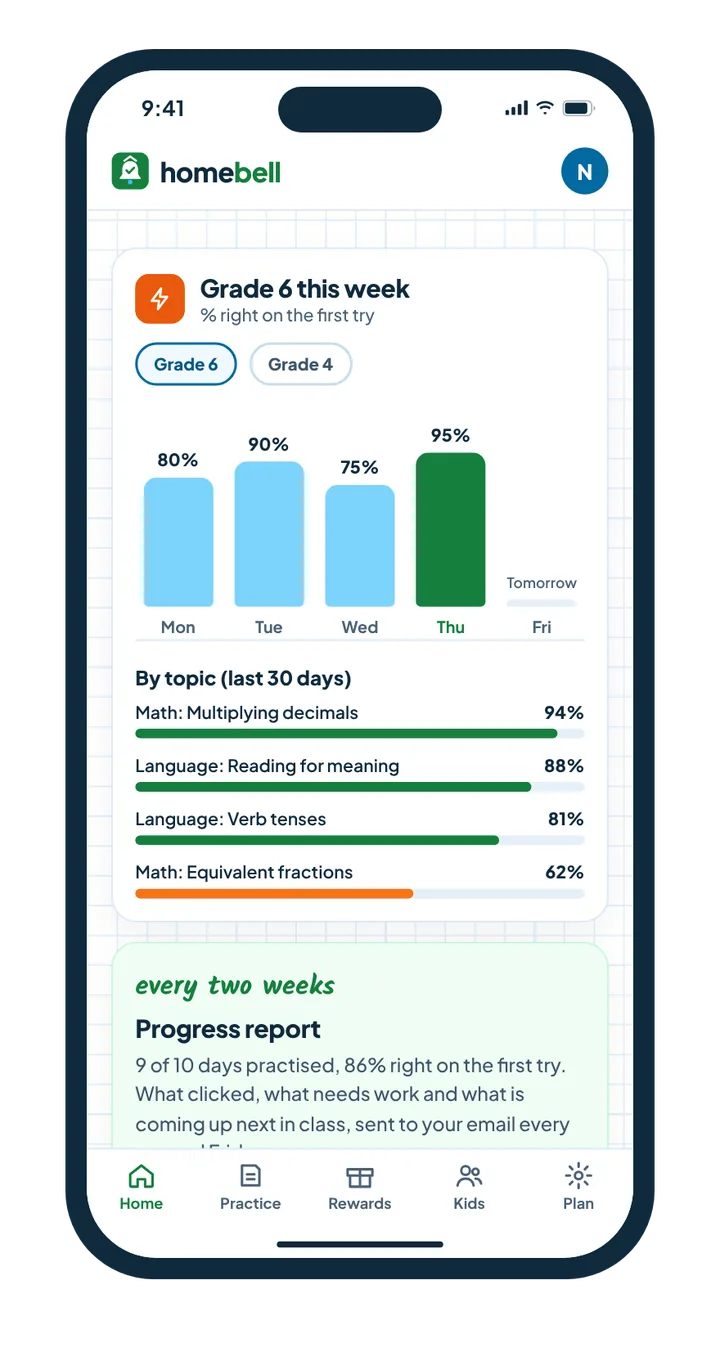
- Your progress report every two weeks shows which topics need more work, so you know where to focus long before May.
Try it free for 7 daysNo card needed for the trial.
Quick answers
Does Grade 6 EQAO count toward the report card?
Schools use EQAO to measure progress across the province. It is not part of the Grade 6 report card mark.
Can my child get accommodations?
Students with an IEP can get the accommodations they normally use in class. Talk to your child's teacher well before the assessment.
Should we buy EQAO prep books?
Not necessarily. Short, regular practice on the Grade 6 curriculum, plus a look at EQAO's free sample questions in the spring, covers it.