If there's one topic that quietly decides how middle school math goes, it's fractions. Fractions lead to decimals and percents, those lead to ratios and rates, and ratios lead to algebra and slope in Grade 9. A gap in Grade 6 rarely stays in Grade 6.
Here's how to tell whether your child has a gap, and how to close it.
Why this gap matters so much
In Ontario, only 51% of Grade 6 students met the provincial standard in math on the 2024 to 2025 EQAO assessment. Number sense, including fractions, decimals and percents, is a big part of what's tested.
The trouble is that fraction gaps hide well. A student can get through a lot of Grade 6 math with decimals and a calculator. Then Grade 7 asks them to multiply and divide fractions, and Grade 8 asks them to solve percent problems and equations with fractions in them. That's when the gap shows up.
The five skills to check
Try these five quick questions with your child. They're roughly Grade 6 to 8 level.
1. Equivalent fractions. What fraction is equal to 3/4 with a denominator of 20? (15/20)
2. Converting. Write 3/8 as a decimal and a percent. (0.375 and 37.5%)
3. Comparing. Which is bigger: 5/8 or 0.6? (5/8, which is 0.625)
4. Operations. What is 2/3 × 3/5? And 3/4 ÷ 1/2? (2/5 and 1 1/2)
5. Percent of a number. What is 15% of 60? (9)
If your child gets all five quickly and can explain how, they're in good shape. If they hesitate, guess, or reach for the calculator on every one, it's worth spending some time here.
Common mistakes and what they mean
| Mistake | What it usually means |
|---|---|
| Adding tops and bottoms: 1/2 + 1/3 = 2/5 | Doesn't yet understand what a denominator represents |
| 0.6 is smaller than 0.25 "because 6 is smaller than 25" | Decimal place value isn't solid |
| 15% of 60 = 15 × 60 | Doesn't connect percent to "out of 100" |
| Can't divide fractions without the "flip" rule | Memorized a trick without the meaning |
None of these are a big deal on their own. They're a big deal when they're still there in Grade 8.
How to close the gap
Use real things. Recipes, sale prices, sports stats and pizza slices make fractions and percents concrete. "The jacket is 30% off $80. What do we pay?" is a real question.
Practise a little, often. Fraction skills get faster with repetition. A few questions a day works better than a big review before a test.
Mix the forms. Keep switching between fractions, decimals and percents. Fluency means seeing 3/4, 0.75 and 75% as the same thing.
Ask for the "why." If your child can explain why 2/4 equals 1/2, they understand it. If they can only do it, they've memorized it.
How Homebell helps close fraction gaps
Homebell gives Grade 6, 7 and 8 students short daily math practice that follows the Ontario curriculum, including number sense topics like fractions, decimals and percents in the order they're usually taught.
- Set up the grade with your school board and Math, plus any other subjects.
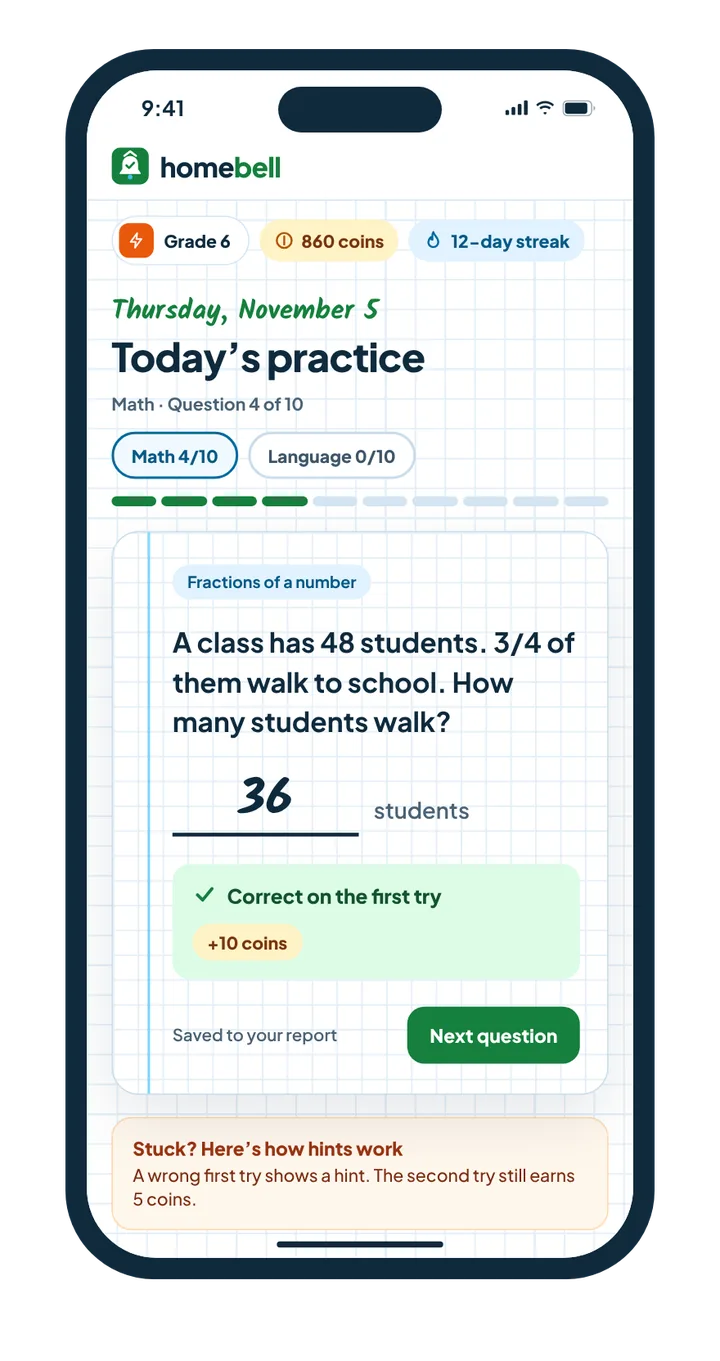
- About 10 questions a day arrive at the time you choose, on school days only. If the class is on fractions right now, practice follows that.
- Every answer is checked on the spot. A wrong answer gets a hint, then a second try, then a short explanation of the method. That's how kids learn why, not just how.
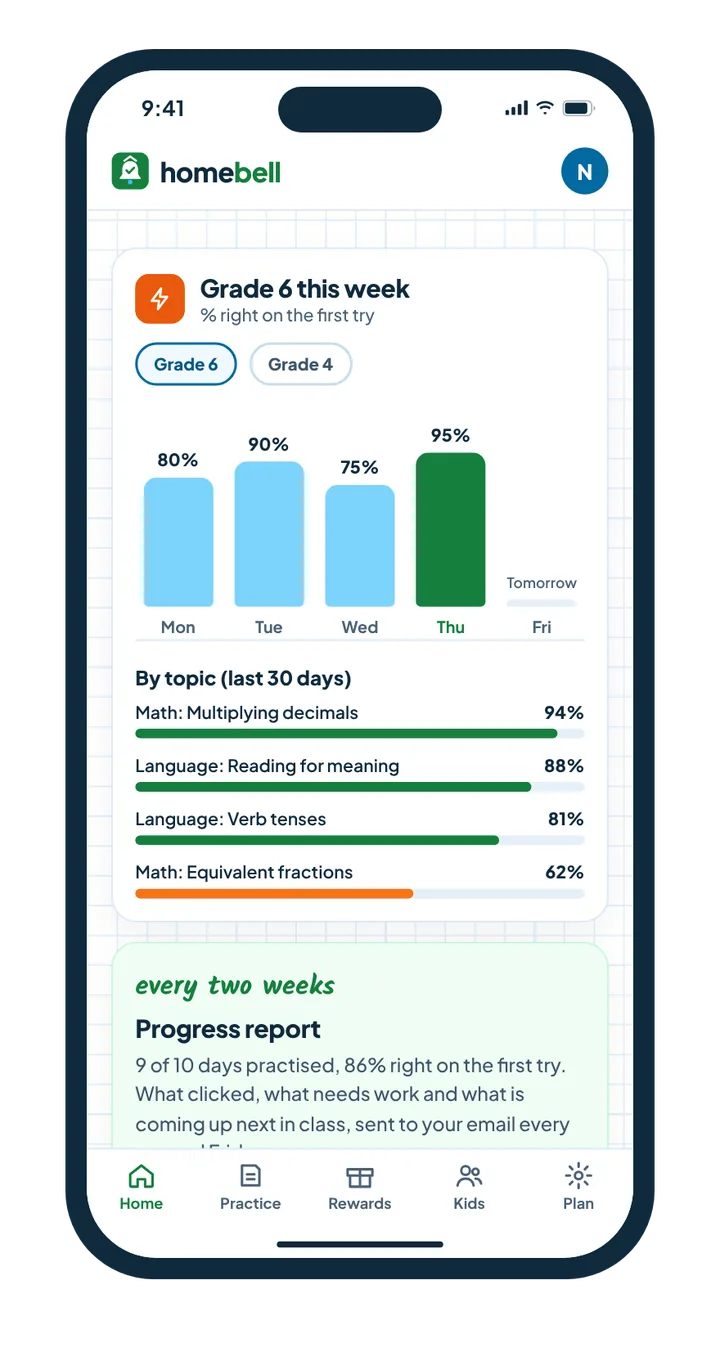
- You see accuracy by topic in the parent dashboard. If fractions keep showing up as "needs practice," you know where to focus.
Try it free for 7 daysNo card needed for the trial.
Quick answers
What grade do kids learn to divide fractions in Ontario?
Operations with fractions build through the junior and intermediate grades, and by Grade 7 students work with all four operations.
Should my child use a calculator for fractions?
For learning, no. Students need to understand fractions without one. Calculators are fine later for checking or for larger problems.
How can I tell if my child has a fraction gap?
Try the five questions in this article. Hesitation on converting or comparing is the most common sign.